eBay Listing Optimisation for Auto Parts: What Actually Improves Sales
Selling auto parts on eBay is not only about having stock. It is about presenting each part in a way that helps buyers find it quickly, understand it instantly, and trust it enough to place the order. eBay's own guidance makes it clear that keywords in listings help buyers find items, while...
Selling auto parts on eBay is not only about having stock. It is about presenting each part in a way that helps buyers find it quickly, understand it instantly, and trust it enough to place the order. eBay's own guidance makes it clear that keywords in listings help buyers find items, while product identifiers improve visibility both on eBay and on external search engines. For parts sellers, that means better performance usually comes from stronger listing structure, not from random edits or guesswork.
Start with the title, not with the design
The title is usually the first thing a buyer and the search system see. If it is vague, overloaded, or missing the key identifiers, the listing becomes harder to understand and easier to skip. eBay specifically advises sellers to use keywords in their listings so buyers can find the item more easily.
For auto parts, a strong title should do one job well: identify the part fast. In most cases, that means putting the most important information in a logical order. Brand, model range, part type, side if relevant, part number, and a clear condition signal usually matter more than filler words. Buyers do not want clever titles. They want certainty.
A better title does not try to say everything. It tries to say the right things first.
Item specifics and fitment are not optional details
One of the biggest mistakes in auto parts listings is treating item specifics like a secondary step. In reality, structured data is part of how the listing gets discovered and filtered. eBay notes that product identifiers help buyers find items on eBay and on external search engines, while compatibility information helps buyers find the right parts for their vehicles.
That matters even more in automotive categories, where buyers often search with very specific intent. They may know the OEM number, the engine code, the vehicle generation, or the exact variant they need. If your listing does not surface that information clearly in structured fields, you lose visibility and trust at the same time.
For that reason, the strongest listings usually include: brand and manufacturer reference, OEM or OE number where available, clear condition, and accurate compatibility or fitment data. When that structure is clean, the listing becomes easier to search, compare, and buy.
Good photos reduce hesitation before the buyer reads anything
Images are one of the fastest trust signals in any eCommerce listing, especially for used auto parts. eBay's picture guidance tells sellers to show the item clearly and make sure flaws or defects are visible in the photos.
That is especially important in auto parts, because buyers want to confirm more than appearance. They want to check connectors, mounting points, labels, wear level, surface condition, and whether the exact part shown matches the description.
In practice, the best-performing listings usually avoid decorative images and focus on proof. That means clean main images, consistent angles, readable labels, close-ups of important technical details, and honest photos of damage or wear. Strong images do not just make the listing look better. They reduce doubt.
Description should confirm what the buyer still wants to know
Once the title, specifics, and photos do their job, the description should answer the final practical questions. It should not repeat the whole title in a messy block. It should help the buyer feel that the part was handled professionally.
For auto parts, a useful description usually confirms: what the part is, its condition, whether it was tested, what is included in the sale, whether coding or programming may be required, and any visible issues the buyer should know before ordering.
This is where many sellers either write too little or write too much. A short vague paragraph feels careless. A huge wall of text feels unhelpful. The better approach is simple structure: a few clear sections, plain language, and no ambiguity about condition or included components.
What usually improves sales first
Sellers often ask what single change makes the biggest difference. In most cases, it is not one isolated trick. It is the combination of four improvements working together:
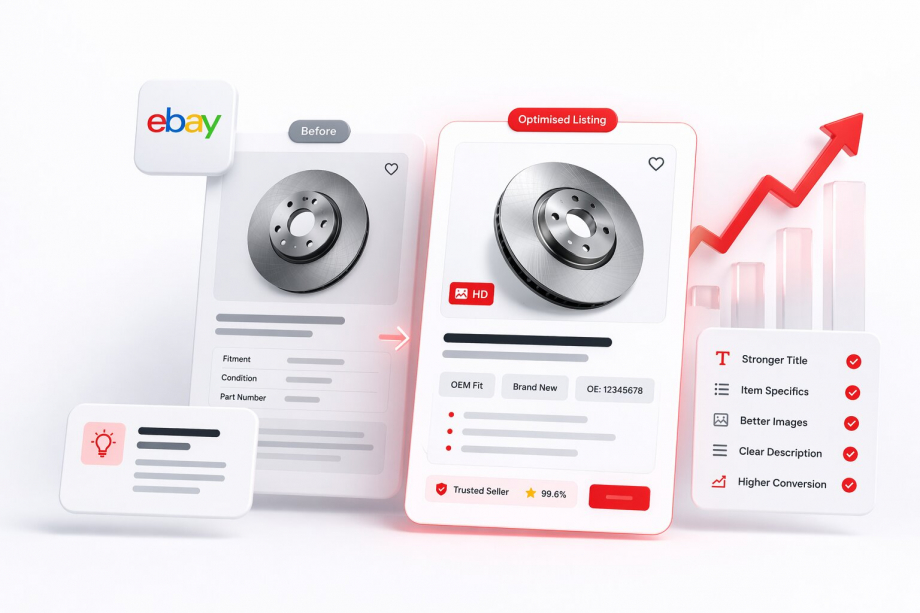
A clearer title helps the listing get found. Structured specifics and identifiers help it appear in relevant searches. Better photos help the buyer trust the part. A cleaner description removes the last buying objections. Those are the improvements that usually move performance in a real and measurable way.
If the listing already has traffic but weak conversion, images and clarity are often the first places to fix. If the listing has low visibility from the start, titles, identifiers, and fitment data usually need attention first.
Optimisation is really about reducing uncertainty
Auto parts buyers are rarely browsing casually. Most of them are trying to solve a specific problem quickly. They want to know whether the part matches, whether the seller looks reliable, and whether the condition is presented honestly.
That is why the best eBay optimisation for auto parts is usually not aggressive marketing language. It is better structure. Better evidence. Better clarity.
When listings are built around accurate product data instead of guesswork, they become easier to scale, easier to trust, and more likely to convert.
Closing thought
If you want better results from eBay auto parts listings, start with the basics that actually influence discovery and buyer confidence: clearer titles, complete identifiers, accurate compatibility data, strong photos, and descriptions that answer real purchase questions. In most cases, sales improve not because the listing says more, but because it communicates the right information in the right order.