Marketplace Integration for eCommerce: Why Website and eBay Sync Should Work Together
Selling through multiple channels sounds simple at first. A business has its own website, an eBay account, and maybe other sales platforms later. In practice, the difficult part is not creating the channels. The difficult part is keeping the product data consistent between them. When stock,...

Selling through multiple channels sounds simple at first. A business has its own website, an eBay account, and maybe other sales platforms later. In practice, the difficult part is not creating the channels. The difficult part is keeping the product data consistent between them. When stock, price, condition, images, and item attributes are updated separately, the system becomes fragile. Small differences turn into real operational problems. That is why marketplace integration matters. Google’s product guidance makes it clear that price and availability are core product attributes shown to potential customers in ads and free listings, and that stores with frequent changes need to keep this information fresh. Google also explains that product data can be provided through structured data on the website, Merchant Center feeds, or both. So the product system is no longer just your website backend. It is part of a wider data network that affects how products appear across channels.
Manual updates create avoidable mistakes
Many stores begin with manual workflows. A product is added to the website, then copied to eBay, then adjusted again later if the item is sold, revised, or discounted. This may work for a very small catalogue, but it becomes unreliable as soon as volume increases. Different platforms end up with slightly different versions of the same product, and the team spends time checking what is correct instead of moving the business forward.
Google Merchant Center documentation directly points to this kind of problem. For mismatched availability, Google says a common cause is the time difference between updates on the website and updates of product data in Merchant Center. It recommends scheduling product data updates to coincide with online-store updates, or using automatic item updates when frequent changes make that difficult. For price mismatch issues, Google’s support guidance says the product price in Merchant Center needs to match the website. These are practical examples of why sync matters: inconsistent timing leads to inconsistent product information.
Stock accuracy protects both sales and trust
One of the most important reasons to sync a website with eBay is stock control. If one product is sold on one channel but still looks available on another, the business faces unnecessary friction. That can mean order cancellations, time-consuming customer messages, and avoidable damage to trust.
Google explicitly states that price and availability are shown to potential customers in ads and free listings. In other words, stock accuracy is not hidden technical data. It is visible customer-facing information. When a store sells through multiple channels, keeping that information aligned is essential. A real integration does not just save admin time. It helps protect the customer experience.
Better sync also supports better visibility
Marketplace integration is not only about preventing mistakes. It also affects how well products can be discovered. On eBay, data quality has a direct connection to visibility. Item specifics, category placement, and attribute completeness influence how well a listing can match buyer intent.
eBay’s Seller Center says item specifics play an important role in increasing visibility on both eBay and external search engines. It also says that the more data sellers provide, the better eBay can match an item to what buyers are looking for through search, filters, and category merchandising pages. The related item specifics guidance also highlights benefits such as better visibility in search results, better chances of being found on eBay, Google Shopping, and external search, and stronger filtering performance on mobile. That means a sync process should not only move titles and quantities. It should also preserve structured product details that improve discoverability.
Integration works best when the catalogue is already structured
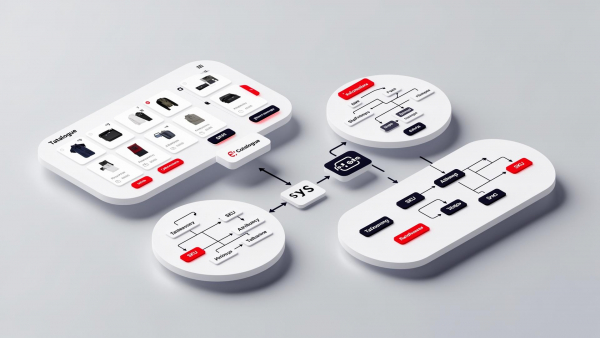
A weak product catalogue cannot be fixed only by adding sync. If categories are inconsistent, item names vary, and attributes are incomplete, the integration only passes messy data from one place to another. Good results come from combining sync with catalogue logic: clear SKUs, consistent product naming, reliable condition fields, mapped attributes, and defined rules for categories and item specifics.
This matters because Google and eBay both rely on structured product information. Google says merchant listings can highlight more specific product data such as price, availability, shipping, and return information. eBay highlights structured item specifics as a key part of search visibility and buyer matching. So the real value of integration comes when structured catalogue data can travel cleanly across the website and marketplace layers.
Automatic fixes are useful, but they are not the system
Some businesses assume that platform-side automation will solve everything. Google does offer automatic item updates and automatic improvements, and these can help correct certain issues based on the landing page. But Google’s own automation guidance says automatic item updates are designed to fix small problems with price and availability and are not meant to be the main method of updating product data. Google also notes that automatic updates can apply to price, availability, condition, and image improvements in Merchant Center.
That is an important distinction. Platform automation can reduce minor mismatches, but it is not a replacement for a proper integration workflow. The stronger solution is still a reliable product system where the website remains the source of truth and connected channels receive accurate updates from it.
Bulk operations become much easier
Once a store grows, the value of sync is felt most in daily operations. Editing listings one by one across channels wastes time and increases inconsistency. A connected workflow makes it easier to revise product data in one place and keep the rest aligned.
eBay’s UK Seller Centre shows this operational need clearly. It provides bulk item-specific download and upload tools, shows which specifics are required or recommended, and prioritises relevant fields based on buyer-demand data. That reflects a broader reality in marketplace selling: scale depends on structured bulk workflows, not repeated manual editing. Website and eBay sync becomes more valuable as catalogue size grows.
Integration helps future-proof the business
A store that depends on manual updates may survive while the catalogue is small. But once the business adds more stock, more marketplaces, or more frequent pricing and availability changes, the old process starts failing. Teams work harder, but the system becomes less reliable. Integration solves this by making the data flow more stable and more predictable.
Google’s structured-data and Merchant Center documentation both show that product information today needs to work across multiple destinations: the website itself, Search, shopping surfaces, and feeds. eBay’s item specifics guidance shows the same pattern on the marketplace side. The businesses that grow more efficiently are usually the ones that build their product system for reuse, not only for one channel at a time.
Final thought
Website and eBay integration is not just a technical convenience. It is a practical way to reduce errors, improve stock accuracy, support search visibility, and save time across daily operations. When prices, quantities, conditions, and attributes stay aligned, the business becomes more reliable for both the team and the customer.
That is why marketplace integration should be treated as part of eCommerce infrastructure, not as an optional add-on. A connected system makes product data more useful, more scalable, and easier to control. And when the catalogue grows, that difference becomes even more important.